Did you mean:
Dialoge31 Results for : dislodge
-

From the Rapidan to Petersburg: The Overland Campaign and the First and Second Battles of Petersburg , Hörbuch, Digital, ungekürzt, 328min
The Overland Campaign that pitted Robert E. Lee against Ulysses S. Grant is one of the most famous campaigns of the Civil War, and perhaps its greatest chess match. While Grant sought to destroy Lee's Army of Northern Virginia along the way to Richmond, Lee aimed to defend his capital while staying alert for a golden opportunity to strike a decisive blow against Grant's Army of the Potomac. The result was an incredibly costly campaign that saw four major battles and near-continuous fighting in May and June, 1864. At the Battle of the Wilderness (May 5-7, 1864), Ulysses S. Grant and Robert E. Lee fought to a standstill in their first encounter, failing to dislodge each other despite incurring nearly 30,000 casualties between the Union Army of the Potomac and the Confederate Army of Northern Virginia. Despite the fierce fighting, Grant continued to push his battered, but resilient, army south, hoping to beat Lee's army to the crossroads at Spotsylvania Court House, but Lee's army beat Grant's to Spotsylvania and began digging in, setting the scene for on and off fighting from May 8-21, which ultimately inflicted more casualties than the Battle of the Wilderness. In fact, with over 32,000 casualties among the two sides, it was the deadliest battle of the Overland Campaign. After Spotsylvania, Grant and Lee both raced to the next natural defensive line, the North Anna River. ungekürzt. Language: English. Narrator: Robin J. Sitten. Audio sample: https://samples.audible.de/bk/acx0/038094/bk_acx0_038094_sample.mp3. Digital audiobook in aax.- Shop: Audible
- Price: 9.95 EUR excl. shipping
-

Different
In Different, world-renowned primatologist Frans de Waal draws on decades of observation and studies of both human and animal behavior to argue that despite the linkage between gender and biological sex, biology does not automatically support the traditional gender roles in human societies. While humans and other primates do share some behavioral differences, biology offers no justification for existing gender inequalities. Using chimpanzees and bonobos to illustrate this point-two ape relatives that are genetically equally close to humans-de Waal challenges widely held beliefs about masculinity and femininity, and common assumptions about authority, leadership, cooperation, competition, filial bonds, and sexual behavior. Chimpanzees are male-dominated and violent, while bonobos are female-dominated and peaceful. In both species, political power needs to be distinguished from physical dominance. Power is not limited to the males, and both sexes show true leadership capacities. Different is a fresh and thought-provoking approach to the long-running debate about the balance between nature and nurture, and where sex and gender roles fit in. De Waal peppers his discussion with details from his own life-a Dutch childhood in a family of six boys, his marriage to a French woman with a different orientation toward gender, and decades of academic turf wars over outdated scientific theories that have proven hard to dislodge from public discourse. He discusses sexual orientation, gender identity, and the limitations of the gender binary, exceptions to which are also found in other primates. With humor, clarity, and compassion, Different seeks to broaden the conversation about human gender dynamics by promoting an inclusive model that embraces differences, rather than negating them.- Shop: buecher
- Price: 14.99 EUR excl. shipping
-

Charging into Immortality: The Life and Legacy of George Pickett , Hörbuch, Digital, ungekürzt, 183min
Before July 3, 1863, George Pickett was best known among his comrades for finishing last in his class at West Point, being a jocular but courageous soldier, and his carefully perfumed locks. As part of West Point's most famous Class of 1846, Pickett was classmates with men like Stonewall Jackson and George McClellan, and despite his poor class standing he distinguished himself fresh out of school during the Mexican-American War. Pickett's reputation for bravery extended into the early years of the Civil War, to the extent that former West Point classmate George McClellan wrote, "Perhaps there is no doubt that he was the best infantry soldier developed on either side during the Civil War." A native Virginian, the impeccably styled Pickett represented all of the antebellum South's most cherished traits, and as such he was a "beau-ideal" Confederate soldier. After proving himself a capable brigadier during the Peninsula Campaign, during which he was wounded and forced to recuperate, Pickett was given command of a division in Longstreet's corps of the Confederate Army of Northern Virginia, putting him in position for a rendez-vous with destiny. Today Pickett is best remembered for the charge that has taken his name and is now remembered as the most famous assault of the Civil War. Having failed to dislodge the Union Army of the Potomac on either flank during the first two days at Gettysburg, Lee ordered a charge of nearly 15,000 at the center of the lines. ungekürzt. Language: English. Narrator: Dan Gallagher. Audio sample: https://samples.audible.de/bk/acx0/089969/bk_acx0_089969_sample.mp3. Digital audiobook in aax.- Shop: Audible
- Price: 9.95 EUR excl. shipping
-

The Lemon Jell-O Syndrome , Hörbuch, Digital, ungekürzt, 512min
A comic novel about the stresses in a small college linguist's personal and professional life. As he loses his wife then his job, Bone King begins suffering a mysterious ailment that prevents him from going through doors. His only hope is renowned neurologist Arthur Limongello. Sometimes Bone King cannot go through doors. He has no physical impairment, but at times his brain and muscles simply can't recall how to walk him through them. Perhaps it has something to do with his being distracted thinking about grammar and etymology all the time, or maybe it's anxiety that his wife is having an affair with the yardman. But then renowned neurologist Arthur Limongello offers a diagnosis as peculiar as the ailment: Bone's self is starting to dislodge from his brain. The treatment is a series of therapeutic tasks; Bone must compliment a stranger each day, do good deeds without being asked, and remind himself each morning that "Today is a good day!" But first, as a temporary measure, he also suggests Bone simply try to dance through the doorways. And for a time, Bone's square dancing, the only kind of dance he knows how to do, seems to more or less work. Bone's condition begins to improve, but then his wife leaves him, and after a harrowing ordeal during which he nearly loses his life, Bone makes an astounding discovery about the man who has been calling himself Dr. Limongello. Is Limongello's remedy the product of a deranged imagination or the cure for a modern epidemic threatening the very self? ungekürzt. Language: English. Narrator: David Aaron Baker. Audio sample: https://samples.audible.de/bk/reco/010236/bk_reco_010236_sample.mp3. Digital audiobook in aax.- Shop: Audible
- Price: 9.95 EUR excl. shipping
-

The Philippines Campaign of 1944-1945: The History of MacArthur's Return and the Allied Liberation of the Philippines , Hörbuch, Digital, ungekürzt, 100min
As American and Filipino troops were in the process of being defeated in the Philippines, General Douglas MacArthur, his family, and his closest advisors were smuggled out of the Philippines on PT boats. From there they surged across the black ocean to Mindanao and were picked up by American B-17 bombers. They stealthily flew to northern Australia, a dangerous flight over Japanese-held territory. On March 18, 1942, MacArthur met the assembled press at Adelaide and told them, "I came through and I shall return". The words would go down in history, and MacArthur would eventually fulfill the vow. In the wake of the campaign, Japan occupied the country and went on to expand their territory in the Pacific while at the same time destroying the American presence in that region. But by the spring of 1943, American military planners had begun to create a plan to dislodge Japan from East and Southeast Asia. To do so, parts of the Philippines were considered main strategic points in the potential Allied attack in the Pacific. The end goal of the Allied plan was an invasion of the Japanese home islands, in which heavy aerial bombardment would precede a ground assault. In order for this to occur, Allied forces would have to occupy areas surrounding Japan, with China adding to Luzon (the largest island in the Philippines) and Formosa (a large island off the coast of China) to create a triangle from which they could launch their bombers. ungekürzt. Language: English. Narrator: Todd Van Linda. Audio sample: https://samples.audible.de/bk/acx0/040811/bk_acx0_040811_sample.mp3. Digital audiobook in aax.- Shop: Audible
- Price: 9.95 EUR excl. shipping
-

The Greatest Civil War Battles: The Battle of Stones River (Murfreesboro) , Hörbuch, Digital, ungekürzt, 61min
In all, 58 pieces of artillery played upon the enemy. Not less than 100 shots per minute were fired. As the mass of men swarmed down the slope they were mowed down by the score. Confederates were pinioned to the earth by falling branches. - G. C. Kniffin, aide to General Crittenden Americans have long been fascinated by the Civil War and its biggest battles, particularly Gettysburg, Antietam, and Shiloh, all of which involved Robert E. Lee or Ulysses S. Grant. But one of the six biggest battles of the war, and the one that took the heaviest toll by percent on both armies was fought at the end of 1862 in Tennessee, and it involved neither of those generals. In late December 1862, William Rosecrans' Union Army of the Cumberland was contesting Middle Tennessee against Braxton Bragg's Army of Tennessee, and for three days the two armies savaged each other as Bragg threw his army at Rosecrans in a series of desperate assaults. Bragg's army was unable to dislodge the Union army, and he eventually withdrew his army after learning that Rosecrans was on the verge of receiving reinforcements. Though the battle was stalemated, the fact that the Union army was left in possession of the field allowed Rosecrans to declare victory and embarrassed Bragg. Though Stones River is mostly overlooked as a Civil War battle today, it had a decisive impact on the war. The two armies had both suffered nearly 33% casualties, an astounding number in 1862 that also ensured Rosecrans would not start another offensive campaign in Tennessee until the following June. The Union victory also ensured control of Nashville, Middle Tennessee, and Kentucky for the rest of the war. ungekürzt. Language: English. Narrator: Chris Abell. Audio sample: https://samples.audible.de/bk/acx0/038818/bk_acx0_038818_sample.mp3. Digital audiobook in aax.- Shop: Audible
- Price: 9.95 EUR excl. shipping
-
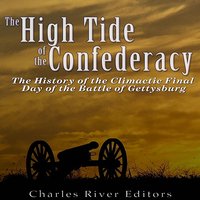
The High Tide of the Confederacy: The History of the Climactic Final Day of the Battle of Gettysburg , Hörbuch, Digital, ungekürzt, 137min
Without question, the most famous battle of the war took place outside of the small town of Gettysburg, Pennsylvania, which happened to be a transportation hub that served as the center of a wheel with several roads leading out to other Pennsylvanian towns. From July 1 to 3, Robert E. Lee’s Confederate Army of Northern Virginia tried everything in its power to decisively defeat George Meade’s Union Army of the Potomac, unleashing ferocious assaults that inflicted nearly 50,000 casualties in all. Day one of the battle would have been one of the 25 biggest battles of the Civil War itself, and it ended with a tactical Confederate victory, but over the next two days, Lee would try and fail to dislodge the Union army with attacks on both of its flanks during the second day and a massive attack against the center on the third and final day. Given that the Army of Northern Virginia would never muster another invasion of the North after Gettysburg and that the Confederates had mixed success the first two days of the battle, the third day is often remembered as the “high tide” or “high-water mark” of the Confederacy, symbolizing its last real chance to win the war. As a result, the most famous attack of the Civil War was also one of its most fateful and fatal: Pickett’s Charge, the climactic assault on the final day of the Battle of Gettysburg, which has become the American version of the Charge of the Light Brigade and one of the most famous events of the entire Civil War. ungekürzt. Language: English. Narrator: Scott Clem. Audio sample: https://samples.audible.de/bk/acx0/119958/bk_acx0_119958_sample.mp3. Digital audiobook in aax.- Shop: Audible
- Price: 9.95 EUR excl. shipping
-

The Dollar Trap: How the U.S. Dollar Tightened Its Grip on Global Finance , Hörbuch, Digital, ungekürzt, 749min
The U.S. dollar’s dominance seems under threat. The near collapse of the U.S. financial system in 2008-2009, political paralysis that has blocked effective policymaking, and emerging competitors such as the Chinese renminbi have heightened speculation about the dollar’s looming displacement as the main reserve currency. Yet, as The Dollar Trap powerfully argues, the financial crisis, a dysfunctional international monetary system, and U.S. policies have paradoxically strengthened the dollar’s importance. Eswar Prasad examines how the dollar came to have a central role in the world economy and demonstrates that it will remain the cornerstone of global finance for the foreseeable future. Marshaling a range of arguments and data, and drawing on the latest research, Prasad shows why it will be difficult to dislodge the dollar-centric system. With vast amounts of foreign financial capital locked up in dollar assets, including U.S. government securities, other countries now have a strong incentive to prevent a dollar crash. Prasad takes the listener through key contemporary issues in international finance - including the growing economic influence of emerging markets, the currency wars, the complexities of the China-U.S. relationship, and the role of institutions like the International Monetary Fund - and offers new ideas for fixing the flawed monetary system. Listeners are also given a rare look into some of the intrigue and backdoor scheming in the corridors of international finance. The Dollar Trap offers a panoramic analysis of the fragile state of global finance and makes a compelling case that, despite all its flaws, the dollar will remain the ultimate safe-haven currency. PLEASE NOTE: When you purchase this title, the accompanying reference material will be available in your My Library section along with the audio. ungekürzt. Language: English. Narrator: Dennis Holland. Audio sample: https://samples.audible.de/bk/adbl/018234/bk_adbl_018234_sample.mp3. Digital audiobook in aax.- Shop: Audible
- Price: 9.95 EUR excl. shipping
-

History for Kids: The Battle of Gettysburg , Hörbuch, Digital, ungekürzt, 23min
In Charles River Editors' History for Kids series, your children can learn about history's most important people and events in an easy, entertaining, and educational way. The concise but comprehensive audiobook will keep your kid's attention all the way to the end. Without question, the most famous battle of the American Civil War took place outside of the small town of Gettysburg, Pennsylvania, which happened to be a transportation hub, serving as the center of a wheel with several roads leading out to other Pennsylvanian towns. From July 1 to July 3, Robert E. Lee's Confederate Army of Northern Virginia tried everything in its power to decisively defeat George Meade's Union Army of the Potomac, unleashing ferocious assaults that inflicted nearly 50,000 casualties in all. Day 1 of the battle would have been one of the 25 biggest battles of the Civil War itself, and it ended with a tactical Confederate victory. But over the next two days, Lee would try and fail to dislodge the Union army with attacks on both of its flanks during the second day and Pickett's Charge on the third and final day. Meade's stout defense held, barely, repulsing each attempted assault, handing the Union a desperately needed victory that ended up being one of the Civil War's turning points. After the South had lost the war, the importance of Gettysburg as one of the "high tide" marks of the Confederacy became apparent to everyone, making the battle all the more important in the years after it had been fought. While former Confederate generals cast about for scapegoats, with various officers pointing fingers at Robert E. Lee, James Longstreet, and James Stuart, historians and avid Civil War fans became obsessed with studying and analyzing all the command decisions and army movements during the entire campaign. Despite the saturation of coverage, Americans refuse to grow tired of visiting the battlefield and reliving the biggest battle fought in North America. ungekürzt. Language: English. Narrator: Dan Gallagher. Audio sample: https://samples.audible.de/bk/acx0/098925/bk_acx0_098925_sample.mp3. Digital audiobook in aax.- Shop: Audible
- Price: 9.95 EUR excl. shipping
-

The Odyssey of Echo Company: The 1968 Tet Offensive and the Epic Battle to Survive the Vietnam War , Hörbuch, Digital, ungekürzt, 530min
A powerful work of literary military history from the New York Times best-selling author of In Harm's Way and Horse Soldiers - the harrowing and redemptive account of an American army platoon fighting for survival during the Vietnam War. On a single night, January 31, 1968, some 100,000 soldiers in the North Vietnamese Army attacked 36 cities throughout South Vietnam, hoping to topple that government and dislodge American forces. The 12 American boys of the recon platoon of the 101st Airborne Division, average age 19, are from small farms, California beach towns, and big cities like Chicago, and they are cast into a war they neither understand nor ultimately feel they can win. The fighting was hand-to-hand, nonstop, and waged in endless small battles that forged this group into a lifelong brotherhood of survivors. The Odyssey of Echo Company is about the young men who survived 60 days on the run from the enemy during the Tet Offensive, at the height of the Vietnam War. Each young man lived 100 years in these days and came home to a country that did not understand, and didn't try to understand, what they had survived. They came home winners because they were alive but were losers for having fought there. When they arrived, they landed in San Francisco, took off their uniforms, and walked back into America, where they fell silent and realized that not many wanted to hear the remarkable story they had to tell - until now. Based on hundreds of hours of interviews, dozens of detailed letters written to and from Echo Company soldiers, a huge trove of Pentagon after-action reports, and travel to the scenes of battle with the American soldiers and some of their Vietnamese enemy soldiers, The Odyssey of Echo Company breaks through the wall of time to tell this important story of ordinary people in extraordinary circumstances. ungekürzt. Language: English. Narrator: CJ Wilson. Audio sample: https://samples.audible.de/bk/sans/008053/bk_sans_008053_sample.mp3. Digital audiobook in aax.- Shop: Audible
- Price: 9.95 EUR excl. shipping